I'm very pleased to see my new Catasetum blooming. This is the plant I bought at the orchid show several weeks ago, and I was feeling great trepidation at the prospect of responsibility for a very unusual orchid. So far, so good....
Black and yellow flowers, with a perfume similar to cassis. It's posing outside next to my Russian sunflowers, though I keep it indoors when I'm not photographing the blooms. Here's a closeup:
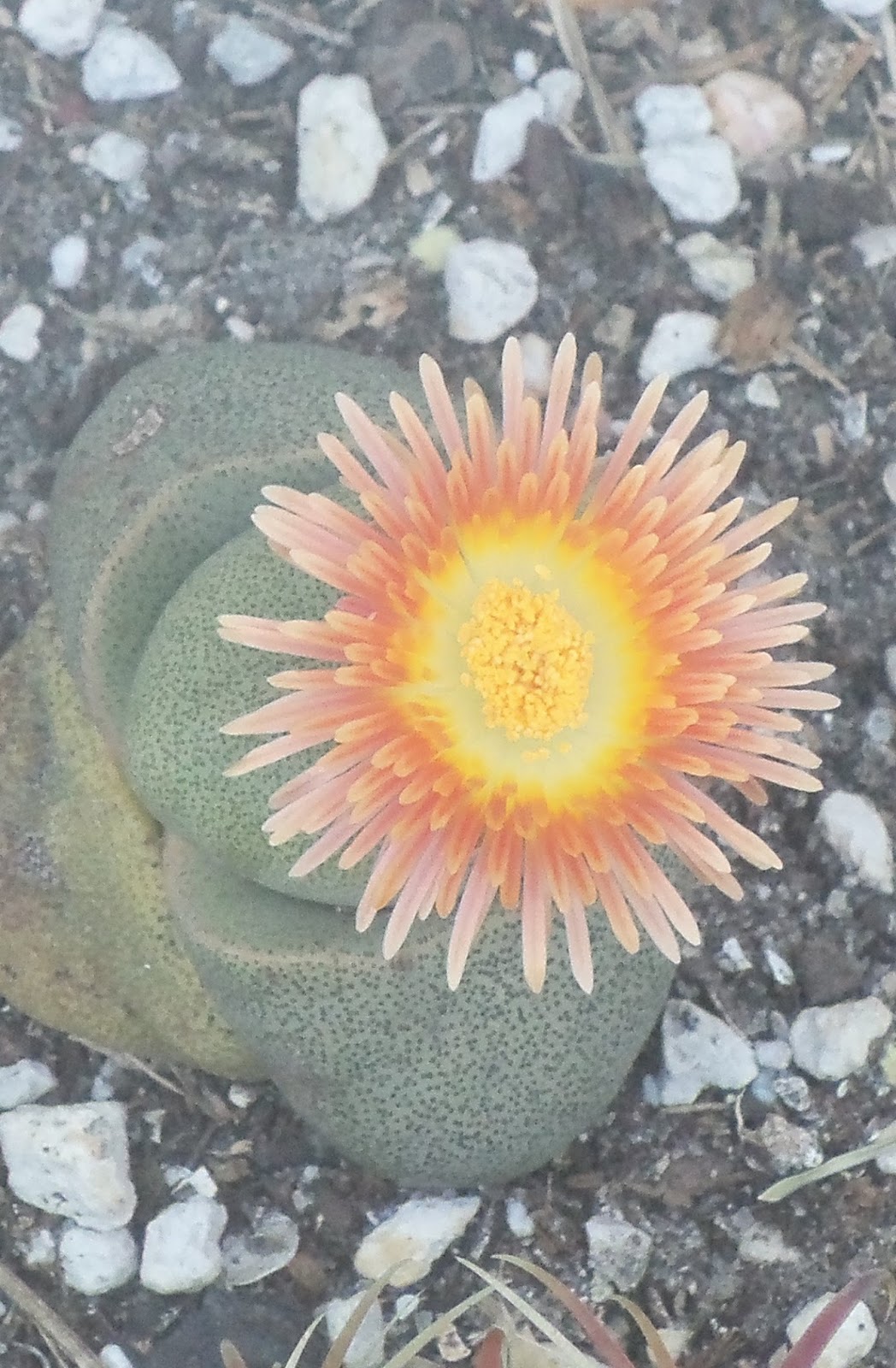
And here's one of my outdoor Pleiospilos, another great bloom:
And here's a perky magenta flower from the robust Marlothistella:
To all my readers, happy blooming and have a great weekend!
Tillandsias, Mesembs, orchids, herbalism, art, pensive musings, and gardening on sand dunes.
Showing posts with label Marlothistella. Show all posts
Saturday, May 18, 2013
Friday, January 4, 2013
Marlothistella: A Tufted Mesemb
A tufted mesemb, what does that mean? Well, if you are tufty, you have fingered leaves, usually textured and packed together. Your stems are short, and of course, your leaves are succulent. In the case of Marlothistella, the tufts multiply exponentially!
This is a fast-growing mesemb that can cover large sections of ground. It can handle a lot of variation in the environment, so I think it would work well outdoors, in a rock garden, or anchoring your fragile hillsides for future generations.
The tufty Marlos are named after the augustly named apothecary and botanist Dr. Hermann Wilhelm Rudolf Marloth (but they just called him "Hermy"), who lived from 1855 to 1931. It grows in only a tiny portion of the Little Karoo of Western Cape Province, South Africa. It likes quartz flats. And sunny spots. And acid soil. When it gets more water, like mine does, the leaves grow more horizontally. During periods of less water, the leaves grow more vertically. They are spotted and slightly fuzzy. I water mine once a week.
This is a fast-growing mesemb that can cover large sections of ground. It can handle a lot of variation in the environment, so I think it would work well outdoors, in a rock garden, or anchoring your fragile hillsides for future generations.
![]() |
| Marlothistella uniondalensis, MR 2012 |
Subscribe to:
Posts (Atom)